Attic pest remediation resolves wildlife or insect colonies nesting directly above ceiling drywall, which left unaddressed sends airborne pathogens, feces dust, and urine vapor through return air ducts into suburban…
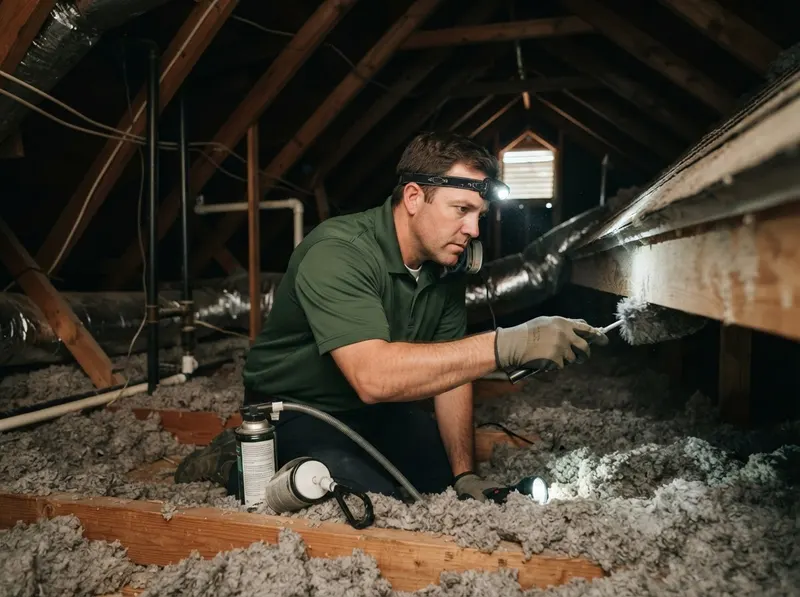
Attic pest remediation resolves wildlife or insect colonies nesting directly above ceiling drywall, which left unaddressed sends airborne pathogens, feces dust, and urine vapor through return air ducts into suburban McKinney homes. In historic structures near Chestnut Square Heritage Village and established properties throughout Stonebridge Ranch or Mallard Lakes, mature tree canopies grant roof rats and eastern gray squirrels immediate jump-points onto fascia boards, soffits, and ridge caps. Newer builds across Craig Ranch, Trinity Falls, and Auburn Hills frequently face house mouse intrusions through unsealed weep screeds, AC chase penetrations, and roof decking seams. Remediation restores living area safety by eliminating nesting materials and sanitizing ceiling framing with non-toxic botanical antimicrobials that neutralize bacteria, histoplasmosis risks, and leptospirosis spores safely around family members and domestic pets.
Selecting between simple pest spot-trapping and full attic pest remediation depends on the duration of the infestation and contamination depth. Trapping alone captures active rodents within 5 to 10 days, but leaves behind pheromone trails that invite subsequent litters into the same rafters while doing nothing to remove fecal layers flattening your R-30 or R-38 blown fiberglass. Full remediation involves vacuuming fouled insulation, treating bare ceiling framing with enzymatic agents to eliminate scent trails, and sealing every 0.25-inch gap along rooflines with galvanized steel hardware cloth. The practical trade-off is higher initial cleanout cost versus permanently ending repeated cyclical DIY trap purchases and avoiding chronic indoor allergen circulation.
Technicians follow a sequential five-step restoration protocol to systematically remediate attic voids. Step 1: Technicians complete a physical top-to-bottom roof, ridge-vent, and interior attic inspection to identify access points, gnawed wire hazards, and pest species. Step 2: Mechanical traps and one-way exit tunnels are installed without poisonous interior baits that could leave rodents dying inside inaccessible wall cavities. Step 3: Once pests are verified gone, technicians bag or vacuum out contaminated fiberglass or cellulose material using sealed HEPA negative-air filtration machines routed through exterior windows. Step 4: Technicians spray all exposed joists and top plates with hospital-grade, pet-conscious biocides to eliminate parasites, mites, and pathogen traces. Step 5: Technicians seal structural entries using 18-gauge 1/4-inch steel mesh, metal flashing, and polyurethane sealant, restoring thermal and physical barriers across the home.
Every job gets a firm, written price after a free on-site visit.
Tell us about your attic pest remediation job in McKinney and we'll send a clear, written quote, usually the same day.
 Old Mill Pest Control